Snack Stand: Pricing with Scatter Plots and Linear Models
Snack Stand Showdown: An 8th Grade Statistics Lab Where Math Makes the Money
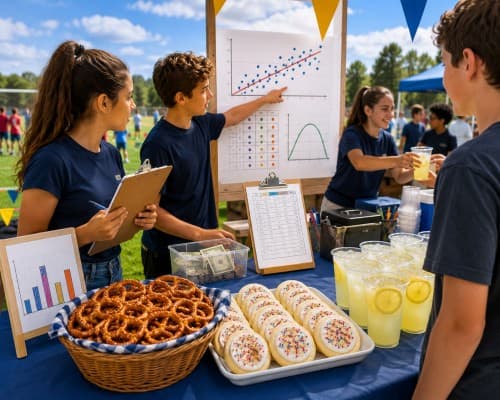
Turn the 8.SP standards into a story your students will not forget. In Snack Stand Showdown, students take charge of a Field Day snack stand selling three products and face two real business questions: what price should we charge, and how many should we buy? Every answer comes from statistics, not guesswork. Students build models from years of past sales data, use those models to set prices, place a real order against a budget, and then watch the event play out to see whether their math paid off.
This is not a worksheet packet. It is a connected, multi-day lab where each activity feeds the next. The scatter plot a student builds becomes the line they fit, the line becomes the profit curve they price from, the price drives the order they place, and the order decides their final profit. Decisions carry consequences all the way to a final settle-up against a $600 profit target.
What students do
- Plot real past-sales data as scatter plots and describe the direction, strength, and outliers in each
- Fit a line of best fit using interactive sliders, then write the linear model in y = mx + b form
- See their own linear model power a profit curve and read the best price off its peak
- Place one combined vendor order within a budget, weighing buyback risk and model quality
- Interpret hour-by-hour sales results, comparing what their model predicted against what actually happened
- Complete and analyze a two-way table to test whether grade level is associated with snack choice
Standards covered
- 8.SP.A.1 Construct and interpret scatter plots, describing association and outliers
- 8.SP.A.2 Fit a straight line to data and assess how well it fits
- 8.SP.A.3 Use the slope and intercept of a linear model to solve problems
- 8.SP.A.4 Build two-way tables and use relative frequencies to investigate association
- Reinforces 7.RP.A and 7.NS.A through proportional reasoning and decimal arithmetic in the budgeting and ordering steps
Why teachers use it
- Fully interactive and auto-graded, with a real-time dashboard showing who started, who finished, and who is stuck
- A built-in lesson on data literacy: students learn that a model predicts but does not promise, and that a loose fit leads to mispricing and leftover loss
- Three products designed to teach three different lessons: one clean dataset, one with an outlier to exclude, and one with a weak association
- No prep required. Each activity includes a learning objective, student instructions, and a teacher tip
- Built for real class time, with seven to ten minutes of genuine mathematical work per activity and no filler
Best for: 8th grade math, Algebra readiness, statistics units, real-world math projects, end-of-unit application, and STEM enrichment. Aligned to Common Core and ready to assign.
Learning Objective