Biz Plan Builder Lab
⬇ Download Teacher GuideBiz Plan Builder Lab
Entrepreneurship: from three ideas to a business plan students can defend
Most business plan assignments end with a template full of guesses. This lab ends with a plan built entirely from things the student found, counted, priced and asked, and it prints as a finished document a judge, a banker or a parent could read.
Over six class periods, students take one small business idea from a rough thought to a ten-section business plan. There is no simulated market and no answer key. Every number in the finished plan is one the student can point to: a competitor's price they actually saw, a crowd they counted, a cost they looked up, a price that five to ten real people responded to. When a reader asks "where did this number come from?", the plan already says.
What students do, day by day
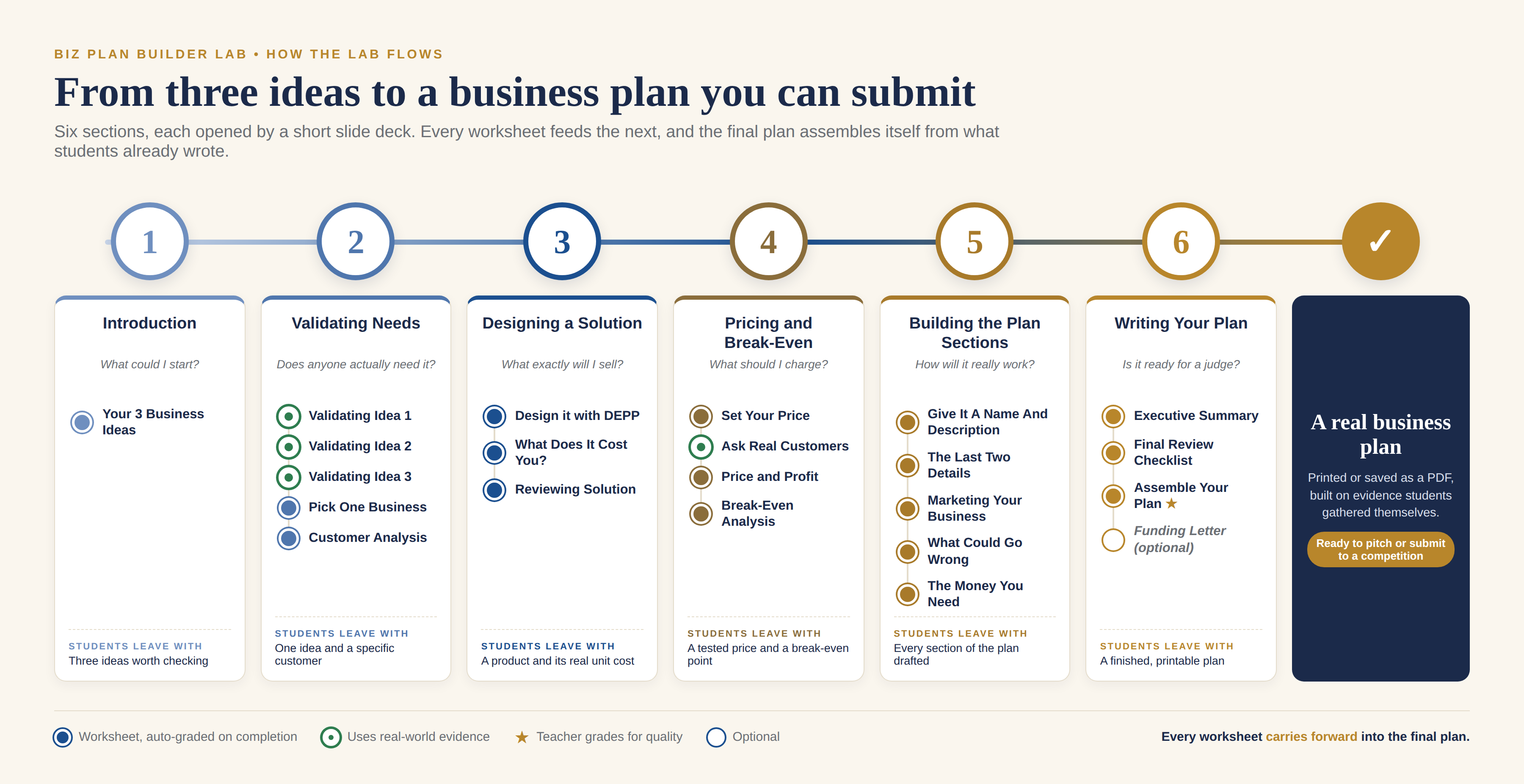
Day 1. Students write down three businesses they could actually start, each with a specific group of people who have an unmet need. Not "everyone likes snacks" but "parents in the stands at Friday home games with nothing to buy."
Day 2. Students research real competitors for all three ideas and record what they charge, then pick one idea and defend it against the other two. They describe their customer so precisely they could point at them, and count how many people the business could reach in a month.
Day 3. Students design the business in four steps, then price every cost: what it takes to open, what arrives every month whether or not they sell, and what one sale costs in materials and their own time. Four fictional advisors read the cost tables back, show the rough range that businesses like theirs usually land in, and ask the questions a real expert would ask. They never hand over a figure. The student keeps their number and says why.
Day 4. Students set a price with their cost as the floor and competitor prices as a signpost, then put it in front of real customers using a four-question script. They keep or change the price based on what they heard, estimate expected sales, find break-even, and see what a first year looks like, including whether the start-up cost pays back.
Day 5. Students name and describe the business, plan marketing with real channel costs that flow into overhead, name three things that could go wrong and what they would do, and work out how much money it takes to open and where it comes from: savings, family, a loan, a grant, or starting smaller.
Day 6. Students write the executive summary, check every line of their plan in a review checklist that shows exactly what they entered and links back to anything missing, then assemble and print the plan. An optional final activity has them write a funding letter to go with it.
What makes this lab different
Real evidence, not simulation. The customer conversations are the heart of the lab. Students ask five to ten people who match their customer whether they would buy at their price, what the most they would pay is, and what they do instead today. The answers feed the price, the sales estimate and the marketing plan. A student cannot finish this lab without having talked to a customer.
Honest numbers. The cost sheet makes students count their own labor, because a business that only works when labor is free is not a business. Every cost table carries a confidence rating (checked, estimated, guessed) that prints in the plan. A business that loses money on paper is shown as such, and the risk and funding sections are where the student responds. Students learn that a plan is believed for its honesty, not its optimism.
No ceiling on ambition, no padding either. Students can price above every competitor if they can say why. They can list one start-up cost instead of three if they explain why. The lab enforces the thinking, not the count.
Works for any business. Product, service or software; a snack stand, a lawn service, a tutoring business, an app. The worksheets ask what one sale is and adjust. A student who already runs a small business enters it with real numbers and uses the lab to grow it.
Everything carries forward. The customer from day 2 appears in marketing on day 5. The unit cost from day 3 is the price floor on day 4. The marketing cost moves break-even. Students see how the parts of a business depend on each other, because their own plan shows it.
A real deliverable. The assembled plan has a cover, executive summary, what the customer gets, customer and market, competition, price, marketing, operations, the numbers, risks, and where the money comes from, plus the customer conversations as an appendix. It prints on about four pages. It is ready for a classroom grade, a school showcase, or a student business competition that accepts a written plan.
Built for the classroom
Six periods of 40 to 60 minutes, plus one 20 to 30 minute homework assignment. Short reading slides students work through on their own, a worksheet, and a summary each day. Every worksheet is auto-graded on completion so students see progress; the finished plan is graded by the teacher on quality, with a ten-point rubric provided. A teacher guide covers pacing, prerequisites and common situations, and each activity comes with a learning objective and teacher tips for the questions students actually ask.
Grades 9 to 12. No prior business knowledge needed. Any student who can search the web, do basic arithmetic, and talk to five people can complete it.
By the end, students can
- Identify a specific customer with an unmet need and say what those people do about it today
- Research real competitors and their prices, or establish through a real search that none exist
- Build a unit cost that includes their own labor, and separate it from monthly overhead
- Set a price above cost and against competitors, test it on real people, and revise it from what they hear
- Estimate expected sales from a counted reach, find break-even, and judge whether a business covers its bills
- Name risks with responses, and say how much money it takes to open and where it comes from
- Write an executive summary a stranger could follow, and assemble a complete business plan
Every student leaves with a document they made, about a business they chose, with numbers they can explain. That is the whole point.